Modular Skid Projects Are Changing How Valve Packages Are Bought
The buying unit is becoming the package
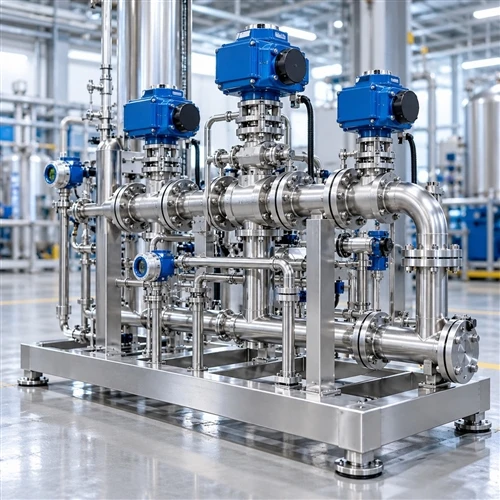
A modular skid is more than a group of parts placed on a steel frame. It is an engineered assembly with piping routes, support structure, valves, instrumentation, controls and defined interfaces. The procurement question therefore shifts from "Which valve do we need?" to "How will this valve work inside the delivered module?"
This shift rewards early coordination. The skid fabricator needs reliable valve dimensions, weights, operating clearances and actuator locations. The buyer needs assurance that each selected product matches the piping class and that the package can be tested before shipment.
Interface details cause the real delays
Flange faces, end connections, control voltages, signal types, cable entries and actuator mounting arrangements may seem like small details. In a compact skid, they are often decisive. A connection mismatch discovered after assembly can trigger rework, delay testing and affect the delivery date.
A strong enquiry states the piping standard, nominal size, pressure requirement, face-to-face limitations, connection type, actuator power supply, control signal, fail action and hazardous-area requirement where relevant. It should also name the drawing revision that governs the supply.
Factory acceptance testing is a procurement advantage
One of the main reasons to use a modular skid is the opportunity to inspect and test the assembled system before it reaches site. Valve buyers can use this stage to verify correct orientation, travel, limit switching, leakage performance, actuator operation and identification.
The test plan should be agreed before production, not requested at the final inspection. Define which valves need functional testing, which documents will be provided and what photographs or records are required. This turns factory acceptance testing into a project-control tool rather than a last-minute formality.
Service access cannot be an afterthought
Compact design should not make future service impossible. A valve may fit physically into the skid, but technicians still need to reach its handwheel, positioner, drain, bolting or packing. Review maintenance access on the general arrangement drawing before fabrication begins.
For critical isolation or control points, ask whether the valve can be removed or serviced without dismantling unrelated piping. The answer may affect support design, spool arrangement and the choice between manual or automated operation.
A practical RFQ structure
For a modular valve package, submit the P and ID, line list, piping class, layout drawing, valve schedule, actuator data and documentation requirement together. State whether the supplier is providing loose valves, pre-assembled valves or a tested subassembly.
This approach gives suppliers enough context to quote accurately. It also helps the buyer compare packages on readiness, not only unit price. In modular work, the least expensive individual valve can be costly if it creates uncertainty at the skid interface.
Why this matters now
Modularization is popular because it can shorten site work and make quality control more repeatable. Valve suppliers that understand this trend will provide better drawings, clearer documentation and more reliable delivery. Buyers who request the complete package will avoid many of the small mismatches that become major problems once a skid is in fabrication.