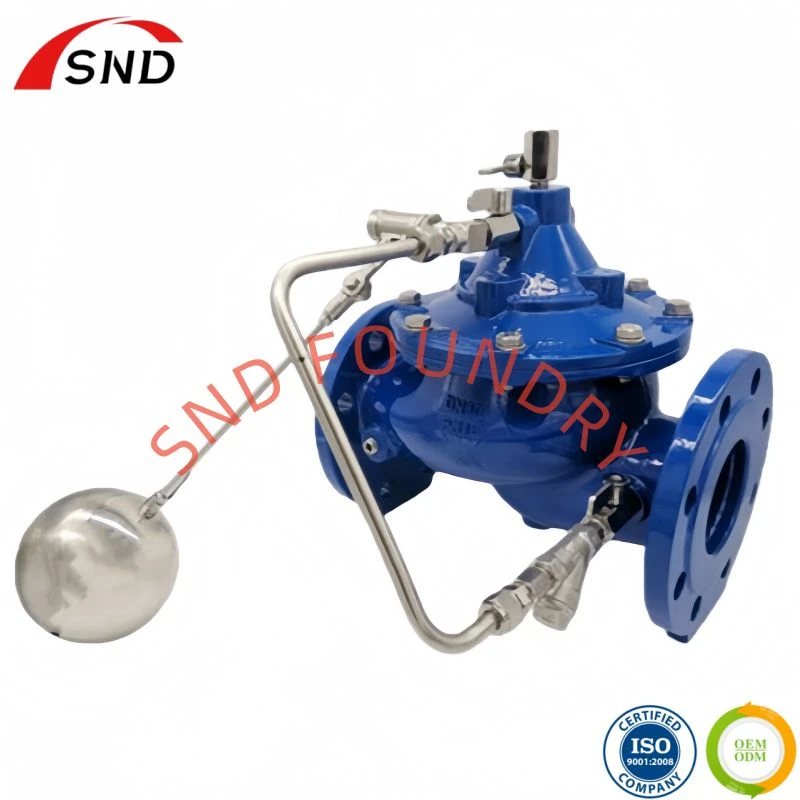


This is an industrial control valve (float-type hydraulic control valve), an automatic valve controlled by the linkage of hydraulic power and a float. It consists of a valve body, a stainless steel float, and a metal pressure-conducting pipe. By sensing the liquid level in the container through the float, it automatically adjusts the valve opening to achieve automated control of water replenishment/stoppage. This industrial control valve (float-type hydraulic control valve) belongs to the category of automatic liquid level control valves.
Parameters
|
Valve body material |
WCB/Stainless steel/Ductile iron |
|
Applicable media |
Oil,Gas,Water |
|
Connection |
Flange |
|
Power |
Hydraulics |
|
Sealing Type |
Soft Seal |
|
Warranty period |
12 months |
|
Certificate |
CE ,IS09001 ,IS014001,IS045001 |
Why choose a soft seal?
The core advantages of soft seals (using elastic materials such as rubber and PTFE as sealing elements) lie in their sealing performance, applicable scenarios, and cost, specifically as follows:
Excellent sealing effect
The elastic material can tightly conform to the sealing surface, achieving zero leakage (especially suitable for cutting off clean media such as water and gas);
Suitable for low-pressure conditions
In medium and low-pressure pipelines of PN16 and below, the seal is reliable and not easily damaged;
Lower cost
Soft sealing materials (rubber/PTFE) are inexpensive, making the overall valve manufacturing cost and maintenance and replacement cost more economical;
Low precision requirements for the sealing surface
Unlike hard seals, there is no need for high-precision grinding of the metal sealing surface, making processing easier.
Advantages
Low cost
No additional power equipment required; installation/operating costs are far lower than electric level valves.
Simple maintenance
No complex electronic components; daily maintenance only requires checking mechanical parts.
High reliability
Purely mechanical structure, suitable for harsh environments such as humid/outdoor conditions.
Good safety
Avoids the risk of electric leakage from electric devices, suitable for water tanks/pools and other water-related scenarios.
Features
No power required
Operates solely on pipeline medium pressure and float buoyancy, requiring no electrical or pneumatic power;
01
Simple structure
Core components are the float, pressure guide pipe, and valve core, minimizing potential failure points;
02
Precise level control
Adjustable float position adapts to different liquid level requirements;
03
High weather resistance
Rust-proof valve body coating and corrosion-resistant stainless steel float.
04
Application Scenarios
Building water supply
Automatic water replenishment for high-rise water tanks and domestic water storage tanks;
Fire protection system
Level maintenance of fire water tanks (ensuring water availability during fires);
Industrial liquid storage
Level control for wastewater treatment ponds and cooling circulating water tanks;
Agricultural irrigation
Automatic water storage for reservoirs and irrigation towers.
Production Process
Valve body machining
Raw material casting → Machining (turning flanges and valve core cavity) → Surface spraying with blue anti-rust coating;
Component assembly
Installing valve core, spring, and other internal components → Connecting pressure guide pipe interface;
Float assembly
Stainless steel sheet stamping and welding into float → Connecting metal connecting rod;
Testing and debugging
Pressure resistance test (verifying no leakage under PN16 pressure) → Simulated liquid level test of valve opening and closing sensitivity.
Routine maintenance
1.Routine Inspection: Check weekly for float sticking, pressure guide pipe loosening, and valve body leaks;
2.Cleaning and Maintenance: Clean float surface monthly (to avoid affecting buoyancy), and flush valve body cavity annually;
3.Component Replacement: Replace valve core seals every 2-3 years (to prevent aging and leakage), and replace float promptly if deformed;
4.Freeze Protection: In low-temperature environments, drain water from valve body (to prevent valve body from freezing and cracking).

Certifications
ISO certification is not only a "qualification threshold" for our company, but also a comprehensive reflection of our company's quality, compliance and competitiveness, driving our company's transformation from "low-end manufacturing" to "high-end standardization".

Company Profile

SND is a leading valve manufacturer specializing in high-performance hydraulic control valves and innovative flow solutions. Leveraging international patents and technological collaborations, we strictly adhere to the ISO 9001 quality management system, ensuring zero defects in our products and earning recognition as an industry benchmark.
Our advanced automated manufacturing processes and integrated network management ensure product reliability and have been approved by China's construction authorities. With a nationwide sales and service network, we are committed to continuous innovation, developing next-generation valve technologies and providing globally leading, reliable, and efficient flow control solutions.
FAQ
Hot Tags: industrial control valve, China industrial control valve manufacturers, suppliers, factory, Pneumatic Control Valve, Globe Control Valve, Industrial Control Valve, control valve