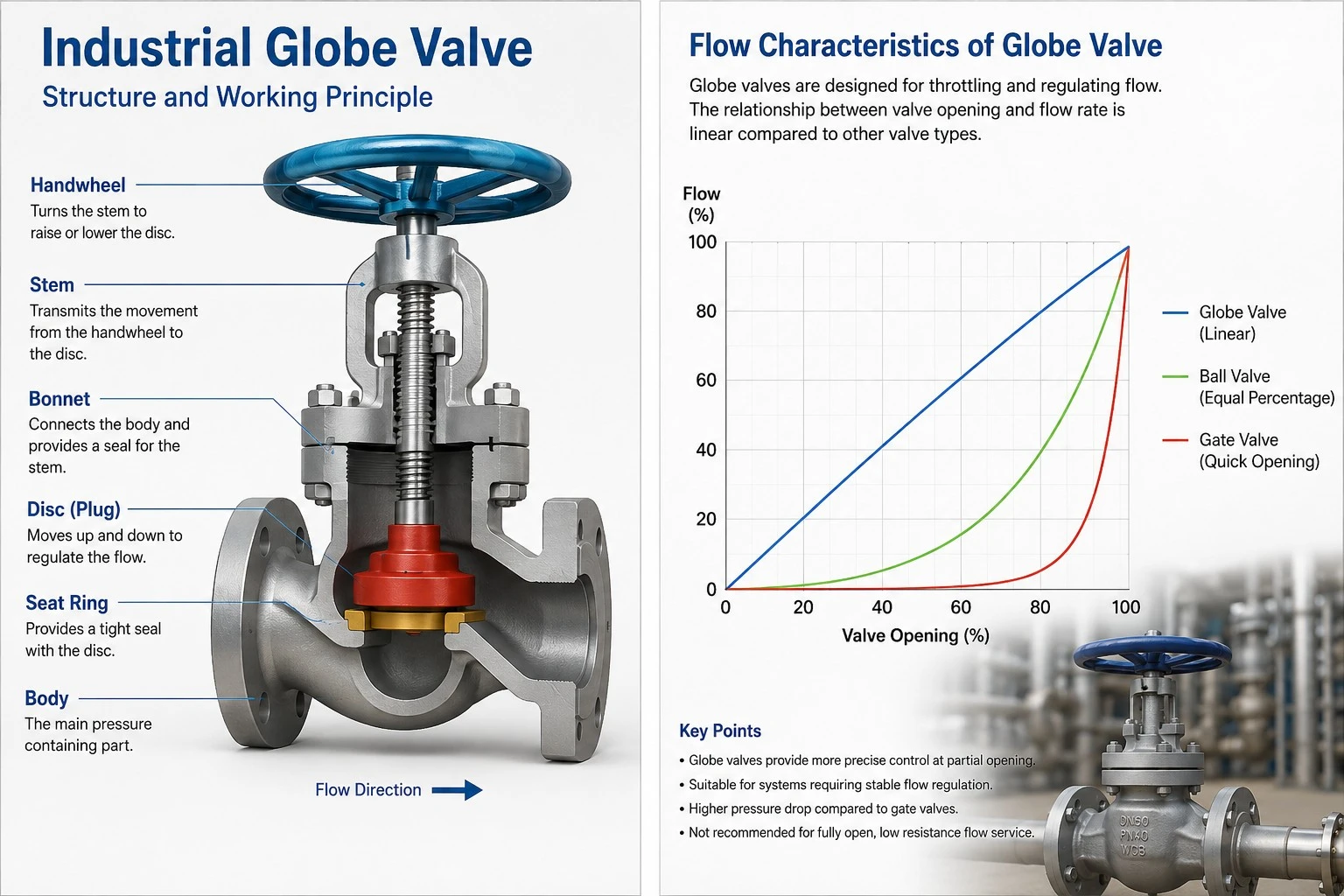
Industrial Globe Valve: A Practical Industry View on One of the Most Important Flow Control Components
In many industrial piping systems, valves are often discussed only in terms of "on/off" or "open/close." But in real engineering practice, the situation is far more complex. A large part of process stability actually depends on how well flow is controlled, not just whether it is allowed or blocked.
This is where the Industrial Globe Valve plays a key role.
It is not the most efficient in terms of pressure loss, and it is not designed for high-speed flow isolation. But when it comes to stable and repeatable flow regulation, it remains one of the most widely used valve types across industries.
Why Engineers Still Rely on Globe Valves
If you look at modern industrial systems-chemical plants, power stations, oil refineries-you will still find globe valves installed in many critical control points.
The reason is simple:
they behave predictably under changing operating conditions.
Unlike valves designed purely for isolation, globe valves are built for adjustment. That means operators can fine-tune flow instead of simply switching it on or off.
In practical terms, this makes them suitable for systems where:
Flow needs to be adjusted frequently
Pressure conditions are not constant
Process stability is more important than energy loss
Manual or automated regulation is required
The Design Idea Behind the Globe Valve
The structure of a globe valve is actually quite straightforward, but very intentional.
Inside the valve, the flow path is not straight. Instead, the fluid is forced to change direction as it passes through the internal disc and seat area.
This design creates resistance-but that resistance is useful.
It allows the valve to:
Respond gradually to opening changes
Provide smoother flow adjustment
Maintain better control at partial opening positions
In other words, it is not designed to minimize resistance, but to control it in a usable way.
What Happens Inside the Valve During Operation
When the valve stem is turned, the disc moves vertically against the seat. This movement directly changes the flow area.
A small adjustment can result in a noticeable change in flow rate, which is why globe valves are often used in control applications rather than simple isolation.
However, this also means:
The valve is not ideal for fully open low-resistance flow systems
Pressure drop is naturally higher than gate valves
Flow direction matters in system design
These are not design flaws-they are expected characteristics.
Common Industrial Applications
In real-world projects, globe valves are typically found in "control points" rather than main pipeline isolation.
Chemical and Process Industry
Used for regulating reaction media, cooling circuits, and dosing systems.
Power Plants
Common in steam lines, boiler feedwater control, and temperature regulation loops.
Oil and Gas Facilities
Used in pressure control sections and refining processes where stability is critical.
General Industrial Utilities
Applied in water, air, and auxiliary systems requiring flow adjustment.
Across all these applications, the key requirement is not maximum flow efficiency, but consistent process behavior.
Advantages Seen in Practical Use
From an engineering and maintenance perspective, globe valves are valued for several practical reasons:
Stable throttling performance over time
Good sealing capability when fully closed
Easier flow adjustment compared to gate valves
Suitable for both manual and actuated control systems
Reliable behavior in frequent operation conditions
These advantages explain why globe valves remain common even in modern automated systems.
Limitations That Should Be Understood
In engineering discussions, it is also important to be realistic about limitations:
Higher pressure drop compared to straight-through valves
Not suitable for large-volume low-resistance flow lines
Can require more operating force in some configurations
Less efficient when used purely as isolation valves
Because of this, globe valves are rarely selected for "open pipeline transport" systems. Their value is mainly in control and regulation.
Final Thoughts
The Industrial Globe Valve is not a "high-efficiency flow device." Instead, it is a control-oriented component designed for stability and precision.
In many industrial systems, what matters most is not how fast a fluid moves, but how consistently the process behaves over time.
That is exactly where globe valves continue to earn their place-not through innovation alone, but through long-term reliability in real operating conditions.